
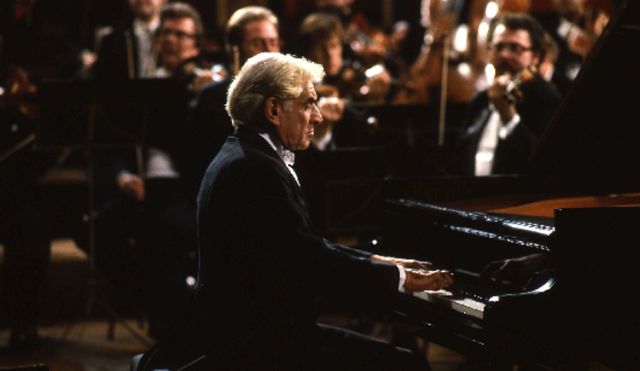
Mozart, Piano Concerto No.17 in G major, K. 453
Throughout his life, Leonard Bernstein had held the music of W.A. Mozart in the highest esteem and particularly enjoyed conducting the piano concertos from the keyboard, playing the solo part himself, as in this recording. In a televised lecture-concert with the New York Philharmonic from Venice's La Fenice Opera House in 1959, Bernstein played the second and third movements of the Piano Concerto in G major K. 453, which he prefaced with the words: "If I absolutely had to name my all-time favorite piece of music, I think I would vote for the Andante we are to hear now. It is Mozart at the peak of his lyrical powers, combining serenity, melancholy, and tragic intensity in one great lyric improvisation. You will hear the tranquillity of a Schubert Lied, the filigree of a Chopin, the brooding of a Mahler. And I would like you to be aware, particularly, of the beauty of its orchestration. This concerto is orchestrally rather modest, even within the already limited frame of the 18th-century orchestra. For instance, it employs neither trumpets nor drums nor clarinets; and yet, wait till you hear the wonders Mozart produces with three solo woodwinds, blending like three glorious voices in an operatic trio, or the rich pathos he can create with a little inner melody played by the violas. Again, even in his orchestration Mozart has transcended his time. [...] And now we emerge from the contemplation and mystery of that almost sacred Andante, into the brilliant light of the Finale. Brilliant - that is the word for this marvelous rococo set of variations. The whole movement is bathed in a glitter that could have come only from the 18th century, from that age of light, lightness, and enlightenment. It is a perfect product of the age of reason - witty, objective, graceful, delicious. And yet, over it all hovers the greater spirit that is Mozart's - the spirit of compassion, of universal love, even of suffering - spirit that knows no age, that belongs to all the ages."