
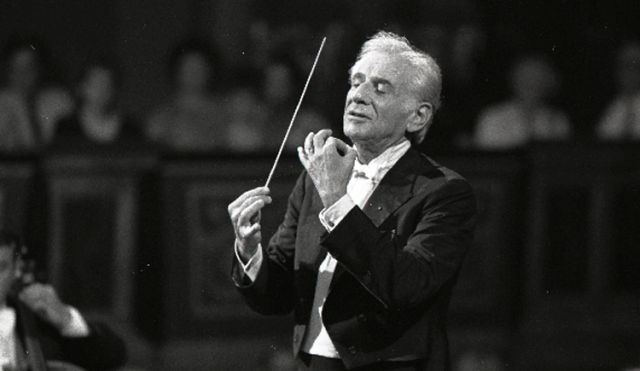
Introduction to Brahms, Academical Festival Overture op.80
"A merry medley of student songs à la Suppé" is how Johannes Brahms characterized his Academic Festival Overture, which he wrote in 1880 as a musical "thank-you note" for the honorary degree conferred upon him by the University of Breslau in 1879. The overture focuses on four traditional German student songs, which are integrated with subtly related themes of Brahms' own invention. The first student tune, "Wir hatten gebauet ein stattliches Haus", is a nostalgic lament for the glorious days of the student associations or "Burschenschaften". The next two songs are the "Hochfeierlicher Landesvater" and the initiation song "Fuchsenritt". After a brief development, the principal themes are reprised and merge into an exhilarating coda built on the joyous "Gaudeamus igitur". Between 1981 and 1984, Leonard Bernstein recorded nearly all of Brahms's orchestral works with the Vienna Philharmonic Orchestra to honor the 150th anniversary of the composer's birth in 1983. Today, the cycle is considered as a landmark in the interpretation of Brahms' music. Bernstein and the Vienna Philharmonic have underscored both the classicism and romanticism, the dramatic intensity and the sober restraint of Brahms's music. The venue was Vienna's Musikvereinssaal, where two of Brahms's symphonies were premiered and where Brahms himself conducted. In his introductions, Bernstein speaks with an eloquence and conviction that go far beyond the opening words to a traditional concert performance. With his stimulating theories on Brahms and his music, Bernstein prompts viewers to listen to the music with an open mind.