
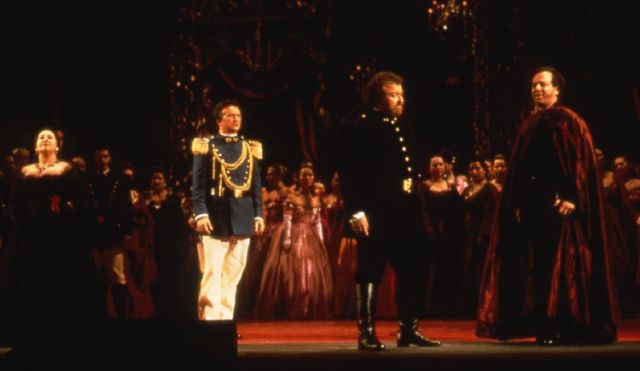
I vespri siciliani
Verdi's opera "I vespri siciliani" was written after "Rigoletto," "Il Trovatore" and "La Traviata," this triumvirate of immortal stage works. It was commissioned by the Paris Opéra and was designed to respect the French taste for large choral scenes and lengthy ballets. The libretto of the "Vêpres siciliennes" was written in verse form by Eugène Scribe and was based on a historical event from the 13th century, when Sicily rose up against the French occupiers. Verdi achieved great success with this work in 1855, and the Opéra continued its collaboration with him twelve years later by commissioning "Don Carlos." The Italian version of the work was premiered that same year and became known throughout the world. La Scala of Milan brought out several major productions of this work, including the one recorded here in 1990. The aristocrat of conductors, the autocrat of the baton, Riccardo Muti cuts a noble figure at the head of any orchestra, and ennobles every ensemble through his charismatic personality and red-blooded musicality. In many respects, including his unwillingness to compromise over artistic matters, he is reminiscent of Arturo Toscanini, who was also a demanding ruler at the podium. His rise to international fame set in with his guest conductorships at the Salzburg Festival in 1971 and at the head of the Berlin Philharmonic and the Philadelphia Orchestra in 1972. Muti became principal guest conductor of the Philadelphia Orchestra a few years later, and was named its music director in 1980. Always a conductor of both the symphonic and operatic repertoire, Muti advanced to the post of music director of La Scala in Milan in 1986. The 1990s saw Muti consolidating his reputation at the head of this venerable institution, as well as in countless other high-caliber venues around the world. Today he is one of the undisputed giants among the leading conductors of the world.