
Così fan Tutte (Mozart 22)
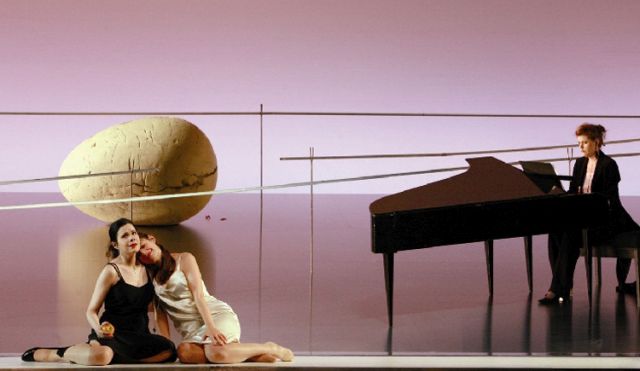
Women are like that, women act that way - no matter how you translate the words "Così fan tutte," it boils down to this: women are impossible to understand! The philosopher Don Alfonso, however, believes he knows how to read women's hearts and is ready to test his theory in a little experiment of love. When Ursel and Karl-Ernst Herrmann's production of "Così" begins, we find Don Alfonso playing with fire. First it's only a cigarette, but then it's the flames of love that he's stoking. And the instrument he's using is ancient, well-worn and very effective: jealousy. Don Alfonso is convinced that the sweethearts of the two soldiers Ferrando and Guglielmo, Dorabella and Fiordiligi, would be unfaithful to them, given the opportunity. The two soldiers are convinced otherwise and bet with him. With the help of the young ladies' maid Despina, Alfonso devises an elaborate scheme to make the two young women believe their lovers have gone off to the army. Then he brings back the two young men, now disguised as "Albanians." Dorabella and Fiordiligi are smitten, and soon fall in love with the handsome strangers, but not with the "right" ones... In their light-footed, witty and poetic staging, the Herrmanns took advantage of the wide stage of the Grosses Festspielhaus to create a luminous and elegantly minimalist landscape dotted with a few sparing but stylish props. The lovers are portrayed with verve and compelling emotional confusion by Ana María Martinez (Fiordiligi) and Sophie Koch (Dorabella) as the two sisters, and Stéphane Degout (Guglielmo) and Shawn Mathey (Ferrando) as the cocky soldiers who learn that lying isn't the best way to find out the truth. Thomas Allen (Don Alfonso) and the great Helen Donath (Despina) add their incomparable stage presence to the action. Conductor Manfred Honeck entices a wondrous delicacy and tenderness from the Vienna Philharmonic. Coming after "Figaro" (1786) and "Don Giovanni" (1787), "Così fan tutte" (1790) is the third of the magnificent trio of operas on libretti by Lorenzo da Ponte. "Così" has long been problematic on account of its libretto, which in earlier days was decried as immoral and in more recent times as politically incorrect. But the beauty of the music and the psychological truth at the heart of the text have ultimately redeemed this opera buffa, which Nikolaus Harnoncourt calls "the saddest opera in the world."