
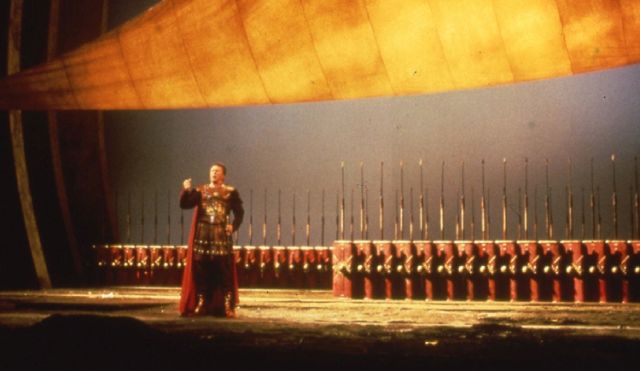
Attila
Stage director Jérôme Savary, known for his colorfully imaginative productions, staged Giuseppe Verdi's early opera "Attila" at Milan's La Scala in 1991. Riccardo Muti led the chorus and orchestra of the celebrated opera house, and the cast included such illustrious names as Cheryl Studer and Samuel Ramey. Giuseppe Verdi wrote altogether five operas for the renowned Teatro La Fenice in Venice. The successful collaboration documents Verdi's ascent to the pinnacle of Italy's opera composers in the second half of the 19th century. It began in 1844 with "Ernani" and continued two years later with "Attila." There followed "Rigoletto" (1851), "La Traviata" (1853) and "Simone Boccanegra" (first version, 1857). The literary source of the opera is the stage play "Attila, King of the Huns" by the German dramatist Zacharias Werner. However, Verdi and his librettists were less interested in the play than in the political message: the struggle for liberation of an oppressed nation from its occupiers. As in "Nabucco" and "I Lombardi," "Attila," too, was intended as a signal of support for the unification of Italy ("Risorgimento") and was enthusiastically understood as such by Italian patriots. The Roman general Ezio offers the entire world to the King of the Huns if he is allowed to keep Italy; Attila refuses and is ultimately killed by a female freedom fighter brandishing his own sword. In the following years "Attila" disappeared from the repertoires of the opera houses; Verdi's global successes such as "Rigoletto," "Il Trovatore" and "La Traviata" seemed more important to international operas houses. Only since the 1950s has the work been staged now and again - as an insider's tip for connoisseurs, who admire the logically constructed action and, above all, the impressive music for four top singers and large chorus. In the score of Attila" one finds enchanting lyrical moments as well as rousing, highly effective passages. The aristocrat of conductors, the autocrat of the baton, Riccardo Muti cuts a noble figure at the head of any orchestra, and ennobles every ensemble through his charismatic personality and red-blooded musicality. In many respects, including his unwillingness to compromise over artistic matters, he is reminiscent of Arturo Toscanini, who was also a demanding ruler at the podium. His rise to international fame set in with his guest conductorships at the Salzburg Festival in 1971 and at the head of the Berlin Philharmonic and the Philadelphia Orchestra in 1972. Muti became principal guest conductor of the Philadelphia Orchestra a few years later, and was named its music director in 1980. Always a conductor of both the symphonic and operatic repertoire, Muti advanced to the post of music director of La Scala in Milan in 1986. The 1990s saw Muti consolidating his reputation at the head of this venerable institution, as well as in countless other high-caliber venues around the world. Today he is one of the undisputed giants among the leading conductors of the world.