
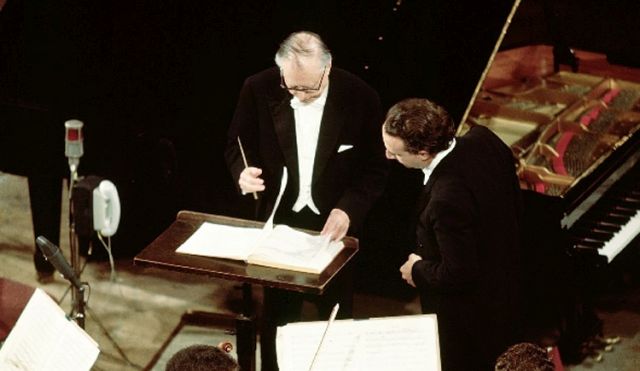
Mozart, Piano Concerto No.23 in A major, K. 488
The soloist in this concerto conducted by Karl Böhm and played by the Vienna Philharmonic Orchestra is Maurizio Pollini, one of the most enigmatic figures in today's musical world. Although he approaches the repertoire in a profoundly spiritual manner, Pollini does not ban brilliance and dazzling virtuosity from his playing. His lyrical and intense art makes him predestined for Mozart, whose works he has been interpreting in a completely new light for many years now. Mozart composed this work during a particularly fruitful period in Vienna in 1786, while he was working on "Figaro," the Masonic Funeral Music and the concertos K. 482 and 491. The A major concerto is one of Mozart's most beloved, perhaps because of its highly contrasting moods, which nevertheless produce an overal impression of Classical unity: the elegant and polished first movement, the poignantly beautiful "siciliano" slow movement and the exuberant Allegro assai finale. The Mozart interpretations of Karl Böhm (1894-1981) perfectly echo the naturalness and clarity of the maestro's conducting. Although Wagner was one of his first loves, Böhm soon discovered Mozart's operas thanks to Bruno Walter, who let him conduct "Die Entführung aus dem Serail" in Munich in the early 1920s. Later, Böhm's friendship with Richard Strauss led to a still deeper knowledge and appreciation of Mozart. In his autobiography, Böhm wrote that "Richard Strauss revealed to me the ultimate secrets of this - in my opinion - greatest musical genius." Böhm's discovery of these secrets turned his Mozart interpretations, such as this one with the celebrated pianist Maurizio Pollini, into unforgettable events.