
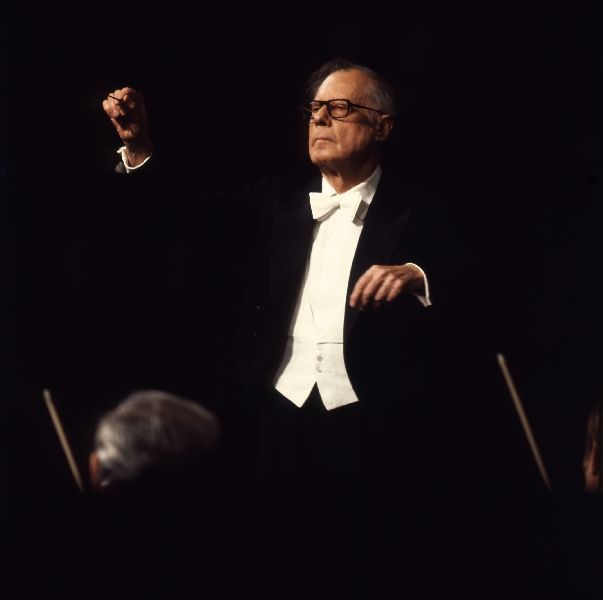
Mozart, Symphony No.40 in G minor, K. 550
Filmed mainly in Vienna's splendid "Musikvereinssaal," the Mozart symphonies conducted by Karl Böhm are all interpreted by one of the world's foremost orchestras, the Vienna Philharmonic Orchestra, whose principal conductors have included Wilhelm Furtwängler, Bruno Walter, Herbert von Karajan, Claudio Abbado and, of course, Karl Böhm. "Thanks to Bruno Walter's exemplary performances, particularly of Mozart's works, I grabbed on to Mozart and fell in love with him so much that I had only one wish: to conduct Mozart, Mozart, Mozart." (Karl Böhm) The G minor Symphony is undoubtedly Mozart's most popular work in this genre. What makes it so exciting to us - and what endeared this work to 19th-century audiences - ar its relentless passion and Romantic tension. The very first bars set the scene: above a nervous, pulsating viola accompaniment enters an equally agitated principal theme. There is nothing spectacular here, and yet the "piano" beginning - unusual for an 18th-century symphony - and the insistent rhythm are nothing less than gripping. The mastery with which Mozart then contrapuntally exploits the opening theme is simply bgreathtaking - particularly in the development section, which darts out into the most distant keys. After the profoundly touching Andante and uncompromising Minuet, the fiery Allegro assai, with its extravagant modulations in the development section, provides a worthy counterpart to the first movement. Karl Böhm was universally acclaimed for his Mozart interpretations. Though Wagner was one of Böhm's first loves, his friendship with Richard Strauss led to a deep knowledge and appreciation of Mozart. In his autobiography, Böhm wrote that "Richard Strauss revealed to me the ultimate secrets of this, in my opinion, greatest of all musical geniuses, Mozart." Böhm's discovery of these secrets transformed his Mozart interpretations into unforgettable events.